Showing posts with label Daring Cook Challenge. Show all posts

Friday, December 17, 2010

The Daring Cooks December 2010 Challenge: Poach to Perfection!

Lately, I have been blogging about joining The Daring Kitchen, an-online community of cooks and bakers who are challenged each month to cook or bake something new and different. Everyone uses the same recipe and then posts their results, with narrative and photographs, on their blog.

Jenn and Jill have challenged The Daring Cooks to learn to perfect the technique of poaching an egg. They chose an Eggs Benedict recipe from Alton Brown, Oeufs en Meurette from Cooking with Wine by Anne Willan, and Homemade Sundried Tomato & Pine Nut Seitan Sausages (poached) courtesy of Trudy of Veggie num num.

I chose the Eggs Benedict recipe.

Surprisingly, poaching an egg was not very difficult technique-wise. It really is all about the timing and there are a few tricks that can help.

• Make sure to use the freshest eggs possible. Farm-fresh eggs will make for the best poached eggs.
• Adding a bit of vinegar to the water will help stabilize the eggs and cook the whites faster, and keeping your water just below boiling point (about 190F) will help keep the fragile eggs from rupturing. Also make sure to salt the poaching water well.
• The other main key to success is to crack your egg into a small bowl first, taking care not to break the yolk. Then it becomes easy to gently slide the entire egg into the water for the poaching process.
• A poached egg is done when the whites are fully cooked and the yolk has just started to solidify but is still runny when you cut it open – usually three minutes. It’s ok to go a little longer though depending on your desired firmness. 
• You can poach eggs ahead of time (about a day). Just immerse them in ice water after poaching, and then keep them in a bowl of water in the fridge. When you are ready to use them, place them in hot (not boiling) water until they are warmed through.

Here's what you'll need for Eggs Benedict:
4 eggs (size is your choice)
2 English muffins
4 slices of Canadian bacon (or plain bacon if you prefer)
Garnish
Splash of vinegar (for poaching)

The hollandaise sauce requires:
3 large egg yolks
1 teaspoon water
1/4 teaspoon sugar
12 tablespoons unsalted butter, chilled, and cut in small piecs
1/2 teaspoon kosher salt
2 teaspoons freshly squeezed lemon juice
Pinch cayenne pepper (optional)

Directions:
1. Fill a medium saucepan halfway with water and bring to a simmer.
2. Cut the chilled butter into small pieces and set aside.
3. Whisk egg yolks and 1 teaspoon water in a mixing bowl large enough to sit on the saucepan without touching the water (or in top portion of a double boiler). Whisk for 1–2 minutes, until egg yolks lighten. Add the sugar and whisk 30 seconds more.
4. Place bowl on saucepan over simmering water and whisk steadily 3–5 minutes (it only took about 3 for me) until the yolks thicken to coat the back of a spoon.
5. Remove from heat (but let the water continue to simmer) and whisk in the butter, 1 piece at a time. Move the bowl to the pan again as needed to melt the butter, making sure to whisk constantly.
6. Once all the butter is incorporated, remove from heat and whisk in the salt, lemon juice, and cayenne pepper (if using).
7. Keep the hollandaise warm while you poach your eggs. Use a thermos, carafe, or bowl that you’ve preheated with warm water.
8. If the water simmering in your pan has gotten too low, add enough so that you have 2–3 inches of water and bring back to a simmer.
9. Add salt and a splash of vinegar (any kind will do).
10. Crack eggs directly into the very gently simmering water (or crack first into a bowl and gently drop into the water), making sure they’re separated. Cook for 3 minutes for a viscous but still runny yolk.
11. While waiting for the eggs, quickly fry the Canadian bacon and toast the English muffin.
12. Top each half of English muffin with a piece of bacon. Remove the eggs with a slotted spoon, draining well, and place on top of the bacon. Top with hollandaise and garnish, and enjoy!
Preparation time:
Eggs Benedict: 20 minutes

Equipment required:
Generally for poaching eggs you need:
• Large shallow pan
• Small bowl (for cracking eggs into)
• Large slotted spoon for lifting out poached eggs
• Timer

For Eggs Benedict:
• Double boiler (for the hollandaise)
• Alternatively a saucepan and heat proof mixing bowl that is large enough to sit on top
• Toaster or oven for toasting English muffins
• Frying pan for cooking bacon
• Thermos, carafe, or bowl (in which to keep the hollandaise warm)

Monday, November 15, 2010

My first Daring Cooks' Challenge: spinach soufflé

A few months ago, a friend of Alan's suggested I join The Daring Kitchen, an-online community of cooks and bakers who are challenged each month to cook or bake something new and different. Everyone uses the same recipe and then posts their results, with narrative and photographs, on their blog. Sounded like fun to me, so here I am...posting the results of my first challenge: a spinach soufflé.

Dave and Linda from Monkeyshines in the Kitchen chose soufflés as our November 2010 Daring Cooks' Challenge! Dave and Linda provided two of their own delicious recipes plus a sinfully decadent chocolate soufflé recipe adapted from Gordon Ramsay's recipe found at the BBD Good Food website. 

Of the three recipes, I chose the watercress / spinach soufflé, a little afraid to invest in the ingredients for the crab and artichoke soufflé or the chocolate soufflé.

A great thing about the challenge is that you're not required to buy new dishes, pans, etc. An alternative is always given. In this case, I could use any 2-quart baking dish that had tall, relatively straight sides. But I thought this would be a great time to purchase a soufflé dish since one was not in my limited kitchen arsenal. 

First stop was Wal-mart where a round soufflé dish costs around $22. No way! But, ah, an oval soufflé dish goes for $9. Go figure. So I purchased the oval dish, feeling proud that I had beaten the system. Imagine my disappointment when I began to re-read the recipe and discovered that the 2 1/2 quart oval dish was too large. Back to Wal-mart, return the oval soufflé dish, go to Target, prices and options the same, on to Tuesday Morning, T J Maxx, and a few other stores. No luck.

The idea of emailing my neighbors came next. Most replies were simply "No," except for my exceptionally comical neighbor who responded, "Do I look like the kind of girl who would own a soufflé dish"? I'm still chuckling about that.

Alan suggested going to Old Time Pottery, which I thought was a wasted trip, but you'll never guess what I found there: a round 2-quart soufflé dish for $2. Yes $2. So I bought two! Don't tell me you wouldn't have. You know you would. 

My set-aside day for the challenge arrived and I have to admit I was nervous. I read and re-read the recipe upteen times and learned, among other things, that soufflé is French for puff up or blow up. I learned about making the roux, adding ingredients and whisking egg yolks over simmering water, preparing them, but not cooking them, for the cooked mixture. I was also told that perhaps the most difficult aspect of the challenge would be to photograph the finished soufflé since what goes up must come down. I was warned to work quickly.

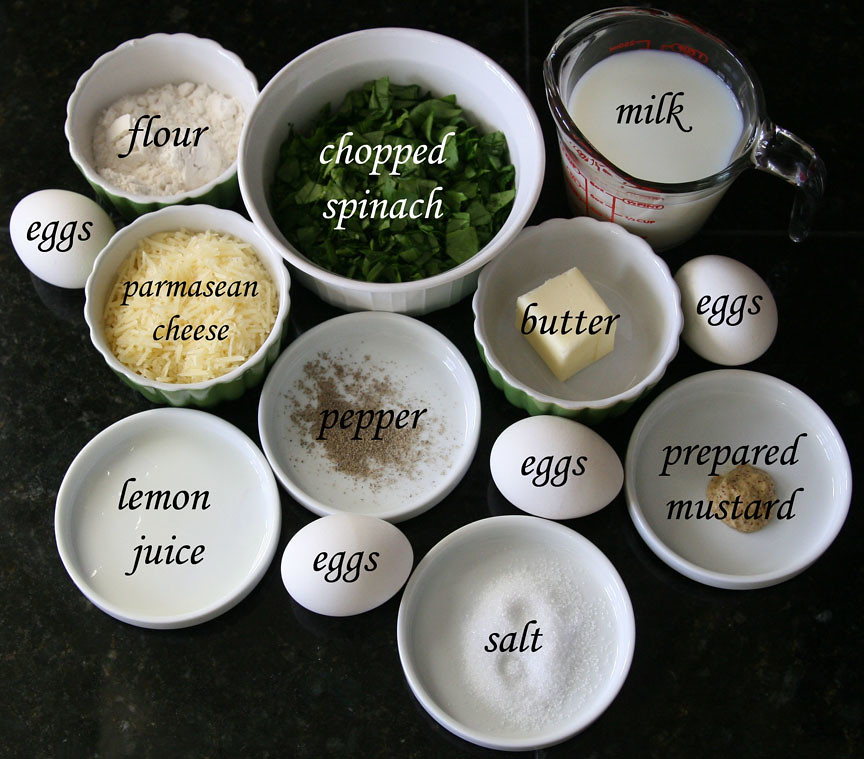
The instructions also suggested that I prepare all ingredients prior to starting the cooking process. 

Here's how my work area looked:


2 tablespoons butter, plus additional for the soufflé dish
3 1/2 tablespoons all purpose flour
1 cup milk
1/2 cup parmesan cheese, finely grated, plus additional for the soufflé dish
1 cup finely chopped de-stemmed watercress (can substitute spinach) - this measure is the leaves after they’ve been washed, de-stemmed, and chopped
4 large eggs, separated
1/2 teaspoon prepared mustard
1/4 teaspoon cream of tartar (a dash {~ 1/2 teaspoon} of lemon juice can be substituted)
Salt and pepper to taste

Directions:

Butter the soufflé dish thoroughly, then grate a small amount of cheese in each dish and tap so that the sides are evenly coated with the cheese. Place the dish in the refrigerator until needed. This helps the soufflé climb.

Preheat oven to 350º F.

Wash and chop the watercress / spinach.

Finely grate the parmesan cheese.

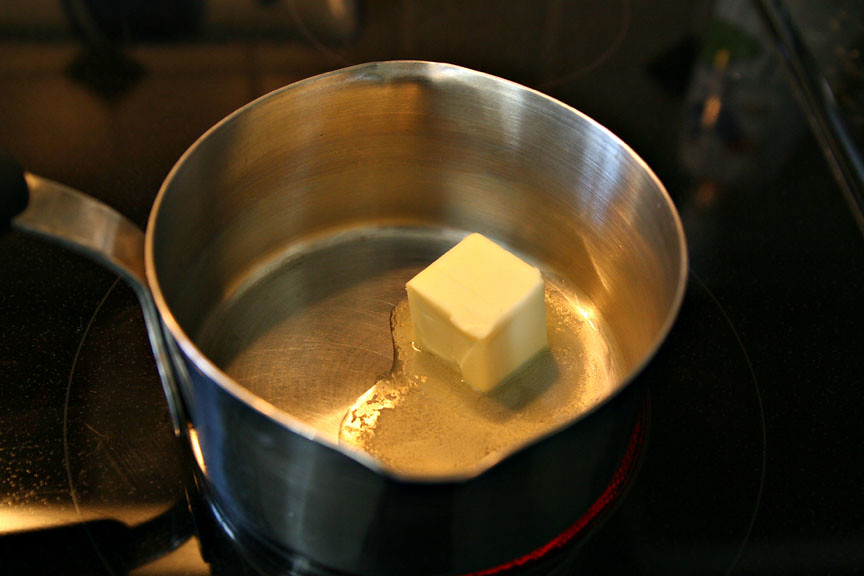
In a medium-size saucepan, melt the butter over medium heat.


Stir in the flour to make a roux. Cook 1 minute, then add the milk, a little at a time, and stir until just thickened, about 1 minute. Add the cheese and stir until it’s just melted. Remove from heat then add the watercress / spinach and salt and pepper.


In a larger pan, bring water to a gentle simmer. (I used a double-boiler with a small amount of water in the bottom pot. I did not allow the water to touch the upper pot.) Whisk the egg yolks in a bowl set just over this water until pale and slightly foamy – about six minutes. Do not allow the eggs to cook.


Mix the egg yolks into the watercress sauce.

Beat the egg whites and cream of tartar until they form stiff peaks yet are still glossy.

Fold the egg whites into the sauce in three additions so that it’s evenly mixed, but too much volume isn't lost.

Remove the soufflé dish from the refrigerator and spoon the mix into it. Use a spatula to even the top and wipe off any spills.


Bake 40 minutes, then serve immediately.


At the end of 40 minutes, I was literally giddy with excitement. The soufflé had risen and looked and smelled divine.

I shared some of the just-out-of-the-oven dish with a friend who commented that it was not only delicious but beautiful. That night, Alan said that every bite was fabulous and he was already looking forward to leftovers the following night.

I will definitely make soufflés in the future, a lot less nervous and a lot more daring!